The short answer is no — there is no age cutoff and no mileage limit for donating a vehicle to Animal Car Donation. Call 1-888-969-4857 or fill out our online donation form and let us evaluate your vehicle today.
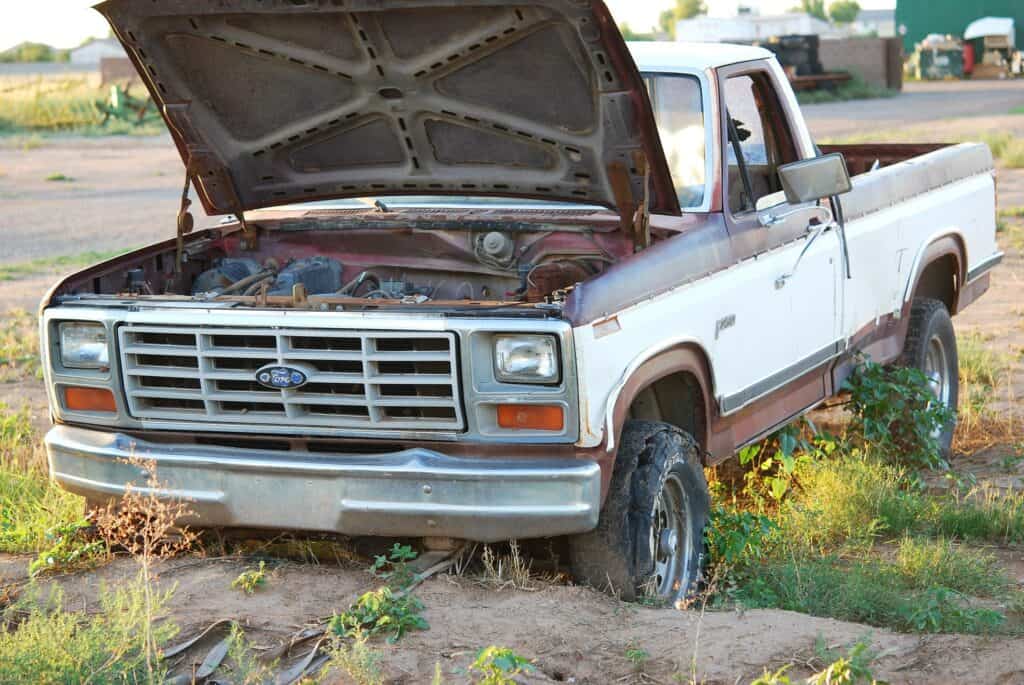
One of the most common reasons people hesitate before donating is the assumption that their car is too old, too high-mileage, or too worn out to be worth anything to a charity. It is a reasonable thing to wonder.
But the reality of how vehicle donation programs work means that age and mileage are rarely the deciding factors — and even vehicles that cannot be resold still generate proceeds for animal welfare charity programs through other channels.
There Is No Year Cutoff and No Mileage Limit
Animal Car Donation does not have a minimum model year requirement or a maximum mileage threshold. We evaluate every vehicle on a case-by-case basis, which means a 2003 pickup with 220,000 miles gets the same honest assessment as a 2018 sedan with 60,000. What matters is not the age or the odometer reading — it is whether the vehicle can generate proceeds through one of the three paths every donated vehicle goes through.
What Actually Happens to an Older or High-Mileage Vehicle
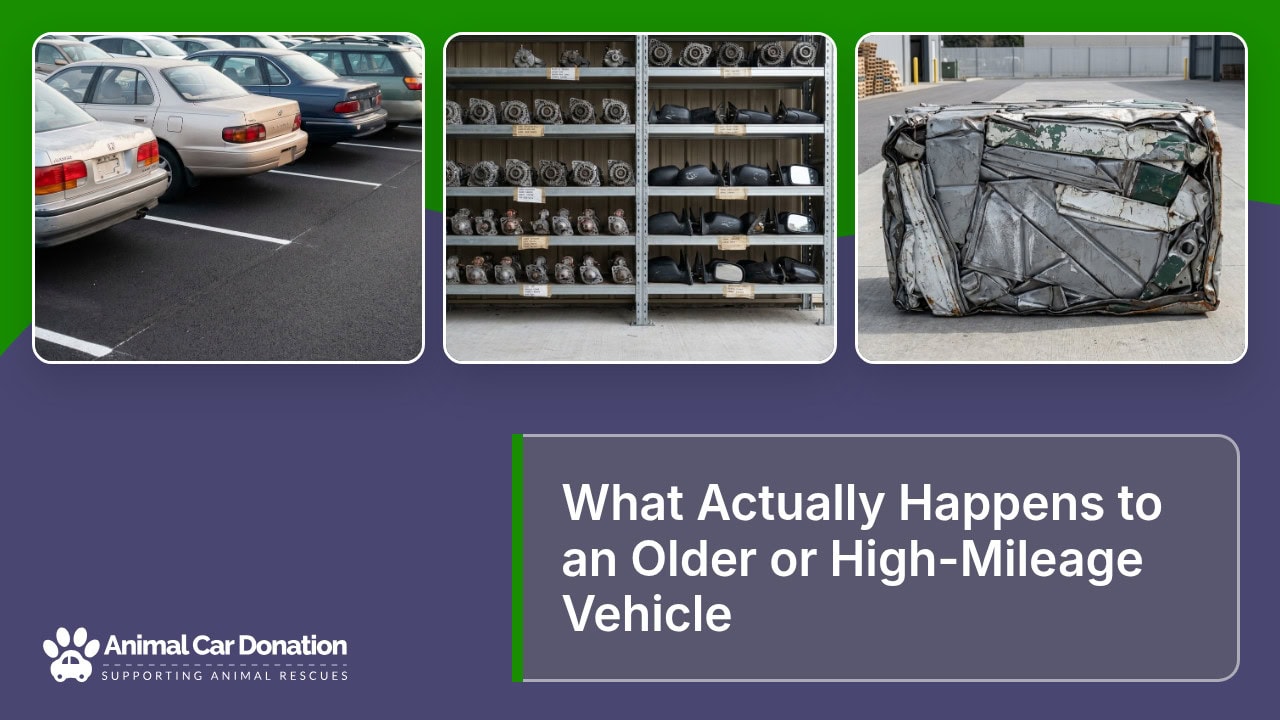
When you donate a vehicle to Animal Car Donation, it goes through a straightforward evaluation process. The outcome depends on the vehicle's condition and market demand — but every path generates proceeds for animal welfare charities.
Path One: Auction Resale
If your vehicle has resale value — even modest resale value — it goes to auction. Older vehicles with high mileage can still attract buyers, particularly when the model has a reputation for longevity or when parts availability makes ownership practical.
A well-maintained older Toyota, Honda, or Ford with documented service history can generate real auction interest even at high mileage. Buyers who specifically shop for affordable, reliable used vehicles show up at auction and bid on exactly these kinds of cars.
Path Two: Parts Salvage
When a vehicle is not viable for resale, it often still has value in its components. Engines, transmissions, body panels, interiors, and mechanical parts all have active secondary markets. Salvage buyers specifically pursue vehicles for parts, and a high-mileage car that would not draw resale interest can still generate meaningful proceeds when its components are evaluated individually. This is particularly true for vehicles with low-demand bodies but reliable, sought-after drivetrains.
Path Three: Recycling
When a vehicle has exhausted its resale and parts value, it goes to recycling. Scrap metal markets assign value based on weight and material composition — steel, aluminum, and other metals all carry real market prices. A vehicle that cannot be resold or parted out still generates proceeds through the recycling process, and those proceeds still flow to animal welfare charity programs through Car Donation Foundation d/b/a Animal Car Donation. No donated vehicle has zero value.
What Your Tax Deduction Looks Like for an Older Vehicle
It is worth setting realistic expectations here. Your tax deduction is based on what your vehicle actually sells for — through auction, parts, or recycling — not on an estimated or book value. For an older, high-mileage vehicle, that number may be modest. If your vehicle sells for $500 or less, you may claim up to $500 or the vehicle's fair market value, whichever is less. If it sells for more than $500, your deduction reflects the actual sale price and we provide IRS Form 1098-C documenting that amount.
For many donors with older vehicles, the tax deduction is a secondary consideration — the primary motivation is getting rid of an unwanted car without the hassle of selling it privately, and knowing it does something good in the process. Free towing, no fees, no negotiations, and proceeds that benefit animal welfare charities make donation a straightforward choice even when the vehicle's market value is limited.
What Can Actually Disqualify a Vehicle
Age and mileage are not disqualifying factors — but a few other things can be. Vehicles without a clear title are the most common barrier to donation. If your vehicle has an active lien, a title in someone else's name without proper legal authorization, or no title at all with no path to obtaining one, the donation process becomes more complicated. Most title situations can be resolved — our team handles title questions every day — but a clear title in your name is the foundation of a straightforward donation.
Vehicles that are structurally compromised beyond the point of any salvage value are rare exceptions that may be declined on a case-by-case basis. But a high-mileage car, a vehicle with mechanical problems, or an older model that has not run in years? Those are exactly the kinds of vehicles our program is built to handle. If you are unsure whether your vehicle qualifies, the fastest answer is a phone call.
How To Donate Your Older Vehicle
The process is the same whether you are donating a two-year-old crossover or a twenty-year-old pickup with a quarter million miles on it.
- Call 1-888-969-4857 or fill out our online donation form. Tell us about your vehicle and we will give you a straight answer on whether we can accept it.
- We schedule free towing at a time that works for you — running or not, wherever the vehicle is located.
- After your vehicle is processed, we mail your tax receipt reflecting the final proceeds. Save it for tax time.
That old car sitting in your driveway is not a lost cause — it is an opportunity. Whatever it sells for, whatever path it takes, its remaining value goes to animal welfare charities doing real work for the animals that need it most. Call 1-888-969-4857 or donate online today.